
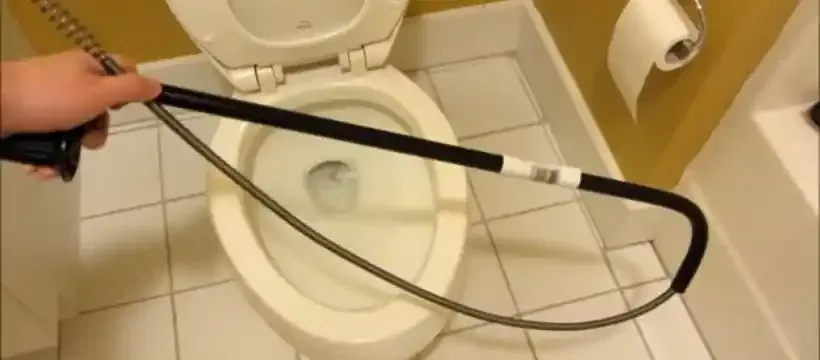
Choose the Right Tool
A standard drain snake can scratch the bowl and may not turn the tight bend in a toilet trap. A closet auger has a curved tube and a rubber sleeve that protect the porcelain and guide the cable through. It is inexpensive and worth having at home.
Gloves, old towels and a bucket make the job less messy. Put towels around the base of the toilet, since some water usually splashes. Do not pour chemical drain cleaner into a toilet before using an auger. Caustic liquid splashes back and hurts.
How To Use a Closet Auger
- 1
Retract the cable
Pull the cable fully into the tube so the head is inside the sleeve.
- 2
Seat the tip
Place the curved end into the bowl opening so the rubber sleeve sits in the drain.
- 3
Crank and push
Turn the handle clockwise while pressing gently forward. Feel for resistance as the head reaches the clog.
- 4
Break or hook the clog
Keep turning to break it up or snag it. Pull the cable back slowly, since it may bring the blockage with it.
- 5
Flush to test
Flush once. If the water drains steadily, flush a second time and confirm the clog is gone.
Mistakes That Make a Clog Worse
Forcing the cable hard can scratch porcelain or push the clog further down, where it is harder to reach. Let the cable do the work and back off if you meet a hard stop. A hard stop could be a foreign object like a toy, which an auger can wedge in.
Another mistake is flushing repeatedly while the bowl is full. Each flush adds water that may overflow. If the bowl rises after the first flush, stop, close the supply valve behind the toilet and use the auger without adding water.
Toilet Clog or Main Line Problem
| What you see | Likely location | Next step |
|---|---|---|
| Only one toilet is slow | The toilet trap or its branch | Plunge or use a closet auger |
| Toilet clogs again right away | A partial blockage past the trap | Call a plumber to cable the branch |
| Toilet and tub gurgle together | The main drain line | Stop water use and see sewer line cleaning |
| Water backs up in a floor drain | The main line or lateral | Stop water use and call |
| Toilet clogged after a child flushed a toy | A hard object in the trap | Call a plumber, since pulling the toilet may be needed |
Toilet Will Not Clear?
Call the 24/7 line. Same-day appointments are offered when available, and you hear the price first.
After the Clog Is Gone
- Flush a couple of times to confirm steady drainage
- Wipe and sanitize the area and tools
- Keep wipes, paper towels and hygiene products out of the toilet
- Use only toilet paper in normal amounts
- Note if clogs repeat, since that can signal a deeper problem
What Usually Causes Toilet Clogs
Most toilet clogs come from too much paper, wipes labelled flushable that do not break down, hygiene products and small objects dropped in by children. Low-flow toilets with weak flushes also clog more often when the rim jets are partly blocked by mineral buildup.
If the same toilet clogs every few weeks, the cause may be in the trap or the pipe beyond it. A plumber can pull the toilet and look, or run a camera, which shows whether a ridge, a root or an old repair is catching paper.
Plunger First, Auger Second
A flange plunger, which has an extra rubber collar, seals better in a toilet than a flat cup plunger. Push gently at first to avoid splashing, then pump steadily for about a dozen strokes. Many clogs break up this way and the auger is never needed.
If the water drains slowly after plunging, wait and try again before reaching for the auger. A slow drain after a clog usually means part of the blockage remains, and the auger can clear what the plunger loosened.
If The Auger Brings Back An Object
Sometimes the cable returns with a toy, a brush head or a wad of wipes. That is good news, since it explains the clog. Flush a few times to confirm the line is clear, and keep small items away from the bathroom.
If you suspect an object but cannot retrieve it, stop. Repeated pushing can lodge it in the bend. A plumber can remove the toilet and recover the object without damaging the fixture or the pipe.
Keeping Toilets Clear Afterward
Use a moderate amount of toilet paper and keep wipes out of the bowl, even those labelled flushable. A small wastebasket next to the toilet gives everyone an easy place for products that should not be flushed.
Once a year, pour a bucket of hot water into the bowl to clear light buildup, and inspect the flapper and fill valve. Small habits and a little attention keep a toilet from becoming an emergency call.
The Sewer Line Rules in Rolling Meadows
The City of Rolling Meadows sewer guide says the property owner owns the sewer lateral from the building to the main. The city asks residents to call Public Works before calling a plumber when a blockage may be in the main, and the city checks the main at no cost. That call can save you a plumber bill if the problem is on the city side.
The guide also recommends a 6 inch cleanout on the lateral and rodding every two to three years with a 6 inch root cutter, because roots enter at joints. If you have a cleanout, a plumber can use it to clear a line that a toilet auger cannot reach.
When to Call a Plumber
Call if the auger does not clear the toilet, if more than one fixture is affected or if sewage is on the floor. A plumber can run a camera and cable through the cleanout, which reaches farther than any home tool.
Our drain cleaning team handles clogs from toilets to main lines, and we serve Palatine as well. Read about Palatine emergency plumbing if you live there.
Sources and Local Rules Behind This Page
Plumbing work in Illinois is governed by the Illinois Plumbing Code, 77 Ill. Adm. Code 890, which municipal inspectors enforce, and the Illinois Department of Public Health licenses plumbers. The ownership and cleanout guidance here comes from the City of Rolling Meadows sewer guide, according to which the owner maintains the lateral to the main.
We name these sources so you can check them yourself. Rules and phone numbers change, so confirm with the city office or the state before you rely on any detail for a permit or a purchase.
Common Questions
It is not recommended, because it can scratch the porcelain. A closet auger is built for toilets.
Repeated clogs can come from a partial blockage, low-flow flushing, flushed wipes or a problem in the line.
No. Chemical cleaners can splash and damage fixtures, and they are not safe to combine with an auger.
The property owner owns the lateral from the building to the city main, according to the city sewer guide.
The city asks residents to call Public Works at 847-963-0500 on weekdays before a plumber.
A 6 inch cleanout and rodding every two to three years with a 6 inch root cutter.
Still not sure what you are dealing with? Call (847) 281-8626 and describe it to our dispatcher.