
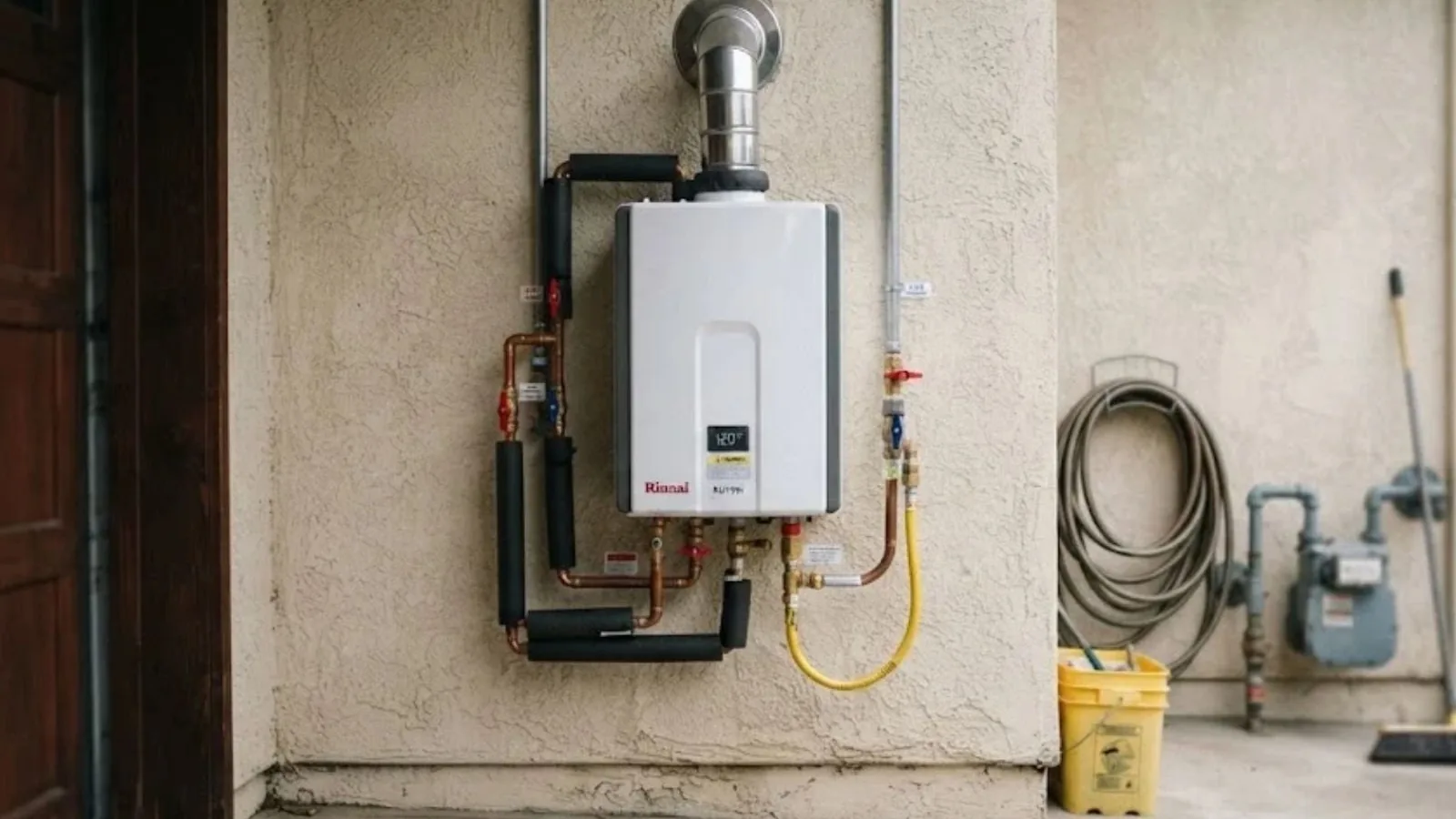
How a Tankless Heater Works
When you open a hot tap, a flow sensor starts a burner or electric elements, and water passes through a heat exchanger and leaves at the set temperature. When the tap closes, the unit shuts off. There is no stored tank, so there is no standby heat loss and no tank to fail and flood the floor.
The trade-off is capacity. A tankless unit has a limit on how many gallons per minute it can heat, so a household running two showers and a dishwasher needs a unit sized for that load, or a pair of units.
Is Tankless Right for Your Home?
| Question | If yes | If no |
|---|---|---|
| Do you want a smaller footprint on the wall? | Tankless saves floor space | A tank may be simpler |
| Is your gas line large enough, or is 240V capacity available? | Install is straightforward | Upsizing adds cost |
| Can the unit vent to the outside correctly? | Good fit | Venting changes add work |
| Do you use lots of hot water at once? | Size the unit carefully, or use two | A smaller unit may work |
If your heater has failed and you want a quick answer, compare it with water heater replacement before deciding.
Flush and Descale Service
Minerals in water leave scale inside a tankless heat exchanger, which narrows the passages, reduces flow and can set off error codes. A flush uses a pump and a mild descaling solution to circulate through the unit and dissolve the buildup.
How often a unit needs it depends on the water and how much it is used. Rolling Meadows publishes no hardness value in its water quality report, so the best guide is the unit itself. If the output temperature fluctuates or flow drops, a flush is the first thing to try. Manufacturers also set their own service intervals, which the plumber can look up for your model.
Tankless Problem?
Call for an appointment. The 24/7 line is open for no-hot-water emergencies, and the price is clear before work starts.
Tankless Problems We Diagnose
Error codes on the display
Codes point to ignition, flow, venting or sensor faults, and the plumber matches the code to the cause.
Cold water bursts in a hot shower
Low flow or scale can cause the unit to cycle on and off.
No hot water at all
A tripped breaker, gas supply issue or ignition fault can be the cause.
Reduced hot water pressure
A clogged inlet filter or scaled heat exchanger restricts flow.
Installing a Tankless Unit
Converting from a tank to tankless usually involves a larger gas line or new electrical capacity, a new vent path for gas models and a condensate drain for high-efficiency units. The plumber checks each before quoting, so the price reflects the whole job.
The City of Rolling Meadows requires a permit for a new or replacement water heater, and that includes tankless installs, per its FAQ. We take care of the permit with the city's Community Development Department. For the broader process, see water heater installation.
Hot Water That Matches Rolling Meadows Homes
Many homes here date from 1950 to 1980, per the city's comprehensive plan, and their gas lines and utility closets were sized for a tank. That does not rule out tankless, but it means the gas and venting review matters. A site visit beats a guess.
If the home has older galvanized supply pipe, low flow may hurt a tankless unit more than a tank. A plumber can check the supply pipe and pressure, and a repiping conversation may belong in the plan.
What Affects the Price
Tankless pricing varies more than tank pricing because the supporting work varies.
Tankless units are not covered by homeowners insurance when they simply wear out. Want your real number? Call (847) 281-8626.
Sources and Local Rules Behind This Page
Plumbing work in Illinois is governed by the Illinois Plumbing Code, 77 Ill. Adm. Code 890, which municipal inspectors enforce, and the Illinois Department of Public Health licenses plumbers. The permit and vent clearance notes here come from the City of Rolling Meadows plumbing FAQ, according to which a new or replacement water heater needs a permit.
We name these sources so you can check them yourself. Rules and phone numbers change, so confirm with the city office or the state before you rely on any detail for a permit or a purchase.
Common Questions
It depends on the water and usage, and manufacturers publish intervals for each model. A plumber can check your unit and tell you.
The city requires a permit for a new or replacement water heater, and we handle it.
It heats continuously, but within its flow limit. If too many fixtures run at once, the temperature can drop.
Often, yes. Many issues are scale, a clogged filter or a sensor, which a plumber can diagnose.
Yes. The emergency line is open 24/7. See emergency water heater repair for how those calls work.
Still not sure what you are dealing with? Call (847) 281-8626 and describe it to our dispatcher.