
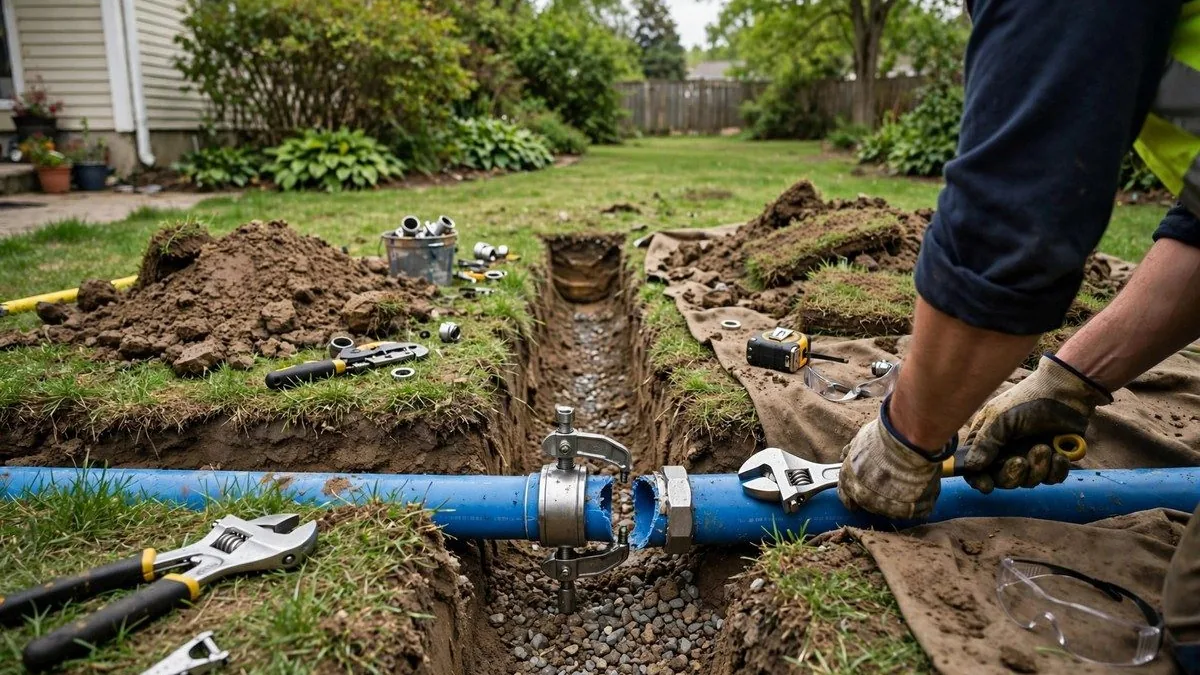
A Water Line Break: First Steps
Signs of a broken service line include water bubbling up in the yard, a sudden drop in pressure, muddy water and a meter that spins. Shut off the main inside the house to stop flow into the house, but keep in mind that water may still leak outdoors from the line up to that valve.
Then work out which side of the property the break is on. If water is surfacing near the street, near the meter pit or at the curb, call Rolling Meadows Public Works at 847-963-0500 on weekdays. If the break is on the home side, call our 24/7 line.
Who Owns Which Part of the Line
| Section | Owner, per the city | Who to call |
|---|---|---|
| Water main in the street | City of Rolling Meadows | Public Works |
| Service line from the main to the shutoff valve or B-box | City of Rolling Meadows | Public Works |
| Service line from the valve into the house | Homeowner | A plumber, such as us |
| Pipes and fixtures inside the house | Homeowner | A plumber |
That split comes from the city's lead service line page. Knowing it can keep you from paying to repair something that is the city's responsibility.
What the City Says About Lead
The City of Rolling Meadows states that it has no known lead service lines. Its most recent lead monitoring results, from 2023, showed a 90th percentile of 0.9 parts per billion against an action level of 15, with no sites over the limit, and the city tests 30 sites every three years. It also says lead can enter water from household plumbing and fixtures, not from the source water.
The city is building an inventory map of service line materials. If your line shows as unknown, the city asks you to report it through its service line survey, and you can ask Public Works about it at 847-963-0500. A plumber who replaces your side of the line will note the pipe material, which can help close the gap.
Water Line Trouble?
Call the 24/7 line. Dispatch will help you work out the city and homeowner sides and offer a same-day appointment when available.
Signs Your Service Line Needs Work
Low pressure at every fixture
A partially failed or corroded line limits flow into the house.
Wet or soft ground between meter and house
Water is escaping from the line underground.
Dirty or discolored water
Corroded pipe sheds rust into the supply.
Meter moves with everything off
A leak somewhere past the meter, which may be the service line.
Repair or Replace the Line
| Approach | Fits when | Considerations |
|---|---|---|
| Spot repair | One leak in otherwise sound pipe | Needs an excavation at the leak |
| Trenchless replacement | The line is failing and the route allows it | Less digging through lawn or drive, but needs the right conditions |
| Open trench replacement | Trenchless is not possible or the line must change route | More digging, with a clearer view of the pipe |
Low Pressure Is Not Always the Service Line
Low pressure can come from the service line, but also from a failing pressure regulator, a partly closed valve, corroded galvanized pipe inside the house or a leak. The plumber checks pressure at an outdoor hose bib and compares it with the pressure inside, then works from there.
If the inside pipe is the problem, the repair belongs on the repiping page. If the line is fine and the pressure is simply high, a regulator may be the fix. We do not recommend a line replacement until we have measured.
Before Any Digging
Any excavation needs utility locates, so call 811 before digging near a buried line. A city permit may also apply for work in the right of way, and the city's Public Works department can tell you the rules for work near the street.
We lay out those steps before you approve the price, and we tell you if work on the city side is outside what we can do. You then know what is ours, what is yours and what belongs to Public Works.
What Affects the Price
Service line work depends on length, depth and what is above the line.
Some homeowners carry optional service line coverage through insurers or utilities. Check your policy. Want your real number? Call (847) 281-8626.
Sources and Local Rules Behind This Page
Plumbing work in Illinois is governed by the Illinois Plumbing Code, 77 Ill. Adm. Code 890, which municipal inspectors enforce, and the Illinois Department of Public Health licenses plumbers. The service line ownership and lead notes here come from the City of Rolling Meadows water pages and its 2025 water quality report, according to which the city has no known lead service lines.
We name these sources so you can check them yourself. Rules and phone numbers change, so confirm with the city office or the state before you rely on any detail for a permit or a purchase.
Common Questions
Yes. The emergency line is open 24/7. Tell dispatch where water is surfacing and whether the main inside the house is off.
The City of Rolling Meadows owns the line from the main to the shutoff valve or B-box, and the homeowner owns it from the valve into the house.
The city states there are no known lead service lines. You can ask Public Works about your address at 847-963-0500.
It depends on length, method and conditions. The plumber gives a realistic window when you approve the price.
Yes. See emergency leak detection for how a buried leak is located without digging up the yard.
Still not sure what you are dealing with? Call (847) 281-8626 and describe it to our dispatcher.